The Modern Developer Needs a Quantum Toolbox
In a recent interview, NVIDIA CEO Jensen Huang spoke about the changing skillset required in the age of AI. As AI makes technical execution more accessible, the skills that become increasingly valuable include…
Cierra Lunde · · 8 min read
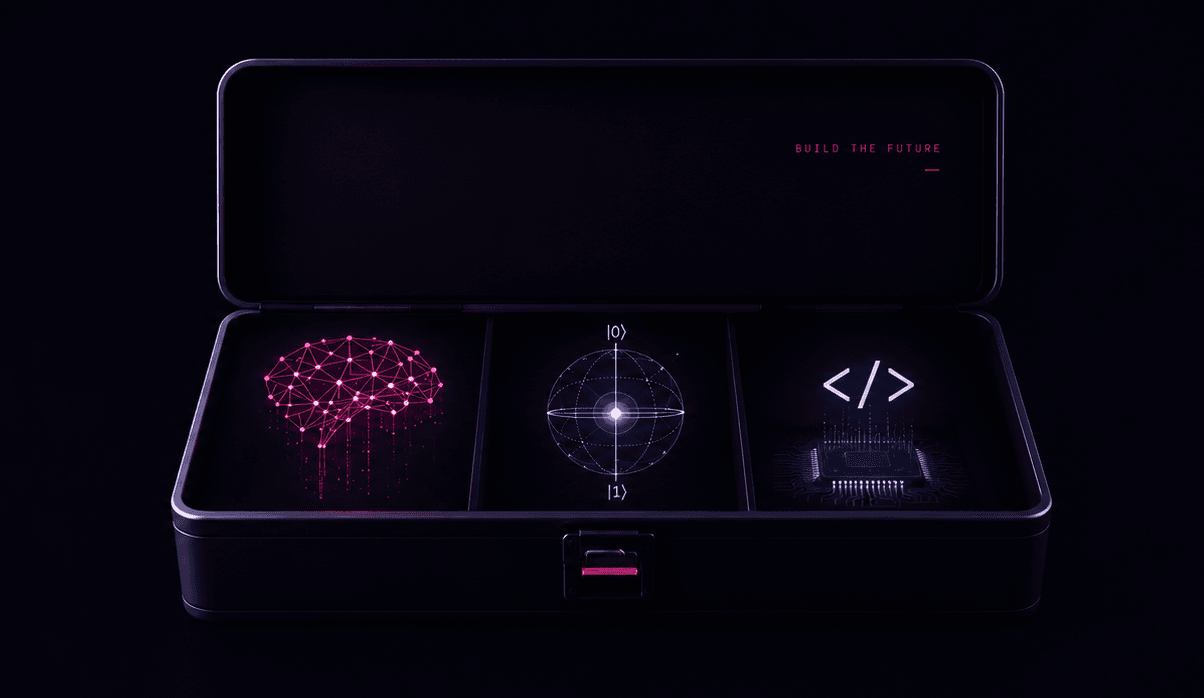
In a recent interview, NVIDIA CEO Jensen Huang spoke about the changing skillset required in the age of AI. As AI makes technical execution more accessible, the skills that become increasingly valuable include creativity, critical thinking, communication, domain knowledge and the ability to solve problems.
This does not mean that the importance of technical knowledge is any lesser, but rather, it is becoming one part of a much larger toolbox.
The World Economic Forum’s Future of Jobs Report 2025 shows that AI and big data, cybersecurity and technological literacy are among the fastest-growing skills, but so are creative thinking, analytical thinking, curiosity and systems thinking.
These are complementary skillsets. A person can have an interesting idea without knowing how to build it. They can also know how to use a tool without knowing what is worth building. The modern developer must have both.
Creativity requires a toolbox
Creativity is sometimes treated as separate from technical knowledge, but creativity in technology is usually combinatorial. It comes from seeing connections between problems, methods and tools that may not have previously been placed together.
In order to creatively solve a problem, a developer needs some understanding of the problem itself. They also need to know which tools exist, what those tools are capable of and where their limitations are.
AI makes it possible to access those tools more quickly. It can help someone generate code, create an interface, interpret documentation or develop a prototype. But it cannot decide, on its own, what is useful.
The value still comes from the person who understands the environment well enough to identify the problem, evaluate possible approaches and assemble the right tools into a meaningful solution.
This is especially important in quantum technology. Quantum computing introduces an entirely different computational model. It will not replace every classical process or make every program faster. But, it will apply to certain types of problems, through certain algorithms, under particular hardware and resource conditions.
A developer does not need to become a quantum physicist in order to engage with the field. But developers will increasingly benefit from having quantum concepts, security risks, algorithms and development tools available within their broader technical toolbox.
The quantum developer is not one person
When people talk about the quantum workforce, they often imagine a highly specialized researcher developing quantum algorithms or working directly with quantum hardware. Those roles are essential. But they are not the only ways developers will interact with quantum technology.
There are at least two areas where quantum knowledge is becoming relevant. The first is cybersecurity, and the second is the development of quantum and hybrid quantum-classical applications. While these require different depths of knowledge, both begin with literacy.
A developer working in cybersecurity may never write a quantum circuit. They may still need to understand why existing public-key cryptography is vulnerable, where that cryptography exists within a system, and how to support a migration to post-quantum standards.
A developer working on optimization, chemistry, finance or scientific computing may not design new quantum hardware. They may still need to understand which algorithms exist, what kinds of problems they address, and how a quantum processor could fit into a larger classical workflow.
Quantum readiness is the process of adding the right quantum knowledge to an existing role.
Quantum security is already a developer concern
The most immediate reason developers need quantum literacy is cybersecurity. A sufficiently capable, fault-tolerant quantum computer could use Shor’s algorithm to break much of the public-key cryptography currently used to secure digital systems. This includes RSA and widely used elliptic-curve cryptographic schemes.
Such a cryptographically relevant quantum computer does not currently exist and timelines vary significantly among experts. But we do agree that migration cannot begin the day the machine arrives.
Organizations first need to determine where vulnerable cryptography exists across their infrastructure. That may include software libraries, certificates, authentication systems, cloud services, network protocols, embedded devices, vendor products and legacy systems. They then need to replace or update those systems without interrupting the services that depend on them.
NIST finalized its first three post-quantum cryptography standards in August 2024 and has encouraged organizations to begin integrating them. Governments and security agencies have also started establishing formal migration milestones extending through the next decade.
There is an additional concern known as “harvest now, decrypt later.” An attacker can collect encrypted information today and retain it until a sufficiently capable quantum computer becomes available. For data that must remain private for many years, the future threat creates a present risk.
This makes post-quantum cryptography a development and infrastructure problem. Developers working in security, networking, cloud infrastructure, identity systems, embedded systems and enterprise software should begin adding several concepts to their toolbox:
- Cryptographic inventory
- Post-quantum cryptography
- Cryptographic agility
- Hybrid cryptographic deployments
- Vendor and dependency management
- Long-term data sensitivity
- Performance and compatibility testing
Post-quantum cryptography should be treated as the primary migration path. Quantum key distribution may also be relevant for narrow, high-assurance environments with dedicated infrastructure and carefully defined threat models. But it is not a general replacement for post-quantum cryptography, and it will not be appropriate for every system.
The creative challenge here is determining how to migrate complex systems that were never designed to change their cryptography easily.
Programming quantum systems requires more than circuits
The second area involves programming quantum computers. There are specific classes of problems for which quantum computing may eventually provide meaningful value. Commonly studied areas include chemistry, materials science, optimization, finance, machine learning and high-energy physics. But identifying a possible use case requires more than learning how to place quantum gates on a circuit.
A developer needs to understand the original problem. They need to determine whether the problem can be expressed in a form compatible with a known quantum algorithm. They need to understand which parts of the workflow should remain classical and which, if any, should be delegated to a quantum processor.
They also need to compare the proposed quantum approach against the best available classical methods. This is where creativity and problem-solving become especially valuable. The quantum computer is another tool, but it is not automatically the right tool.
In many cases, the future quantum developer will work across several systems at once. A classical computer may prepare the data. A GPU may accelerate part of the calculation. A quantum processor may handle a specific subproblem. A classical optimizer may then process the result. The developer’s value comes from understanding how these components fit together.
This is why platforms such as NVIDIA CUDA-Q frame quantum computing within heterogeneous architectures that combine CPUs, GPUs and quantum processors. It is also why IBM’s Qiskit ecosystem increasingly emphasizes quantum workflows rather than isolated circuits. The emerging skill is quantum systems thinking.
Domain knowledge determines what gets built
There is a great deal of discussion about where quantum computers may eventually create value. But use cases emerge when someone understands an important problem well enough to ask whether a different computational method could help solve it.
A chemist may recognize that an approximation used in a molecular simulation is limiting the accuracy of a result. A logistics expert may understand that a scheduling problem contains constraints that are not represented well by a generic optimization example. A materials scientist may know which properties would be meaningful to calculate and which results would be scientifically irrelevant.
A developer with no understanding of those domains may be able to implement an algorithm, but they may not know whether they are solving the right problem. The same is true in reverse. A domain expert may understand the problem deeply but have no reference point for quantum algorithms, hybrid computing or the constraints of current hardware. There is an opportunity between these knowledge areas.
The modern developer does not need to know everything. But they need enough breadth to recognize when a tool may be relevant, enough depth to use it responsibly and enough curiosity to work with people whose expertise is different from their own.
Building the quantum toolbox
For developers interested in adding quantum to their toolkit, there are several useful entry points
- IBM Qiskit provides an open-source software stack for building, optimizing, simulating and executing quantum workloads. Its Python-based environment makes it one of the most accessible starting points for classical developers.
- NVIDIA CUDA-Q introduces quantum development through a hybrid computing model. It is particularly relevant for developers interested in how CPUs, GPUs and quantum processors may eventually operate together.
- The Quantum Algorithm Zoo provides a catalog of quantum algorithms and the types of problems and speedups associated with them. It helps answer a foundational question: what tools already exist?
- Dancing with Qubits by Robert Sutor provides a broad introduction to quantum computing, including the concepts and mathematics that sit beneath the software.
- Learn Quantum Computing with Python and IBM Quantum by Robert Loredo offers a practical path for developers entering through Python and Qiskit.
- Quantum Computing Experimentation with Amazon Braket by Alex Khan introduces hands-on quantum development through the AWS ecosystem.
- Quantum Security Defence offers educational programming around quantum security, post-quantum cryptography and quantum key distribution.
- Quantum for Programmers helps classical developers begin engaging with quantum concepts and software through a developer-oriented lens.
- Qfrontline’s forthcoming Quantum Readiness Community will provide a space for developers, IT teams, security professionals and technically oriented builders to develop practical quantum knowledge through learning, projects and working groups.
A tool is only useful when someone knows that it exists, understands what it does and can determine whether it belongs in the process they are trying to improve.
The future developer is a problem solver
The future developer will still need technical foundations. They will need to understand logic, architecture, security, testing and the behavior of the systems they are building. But code alone will not be the differentiator it once was.
The more execution becomes automated, the more valuable it becomes to understand what should be built. And that requires creativity. It also requires the ability to identify problems, question assumptions, combine knowledge from different fields and select the right tools for a particular situation.
Quantum computing increases this requirement. The field introduces new algorithms, security risks, hardware models and software environments. It gives developers more possibilities, but it also gives them more decisions to make.
Developers do not need to become an expert in every emerging technology, but they do need to build a wide enough toolbox to recognize what is possible and a deep enough foundation to know when and how to use it.